Father McGovern
The Mystery of The Invisible DogFather McGovern, the priest and pastor of St Jude’s Church, is a calm, practical presence in the investigation surrounding the church. His explanations of its Christmas pageant props and key arrangements turn apparent mysteries into questions of access and disguise, even as the church’s missing statue points Jupiter Jones toward the burglar’s use of a costume.
Identity and First Appearance
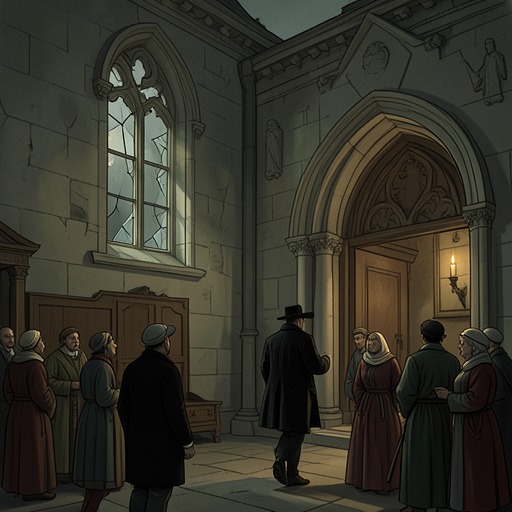
Father McGovern first appears among the spectators outside St Jude’s Church after police order everyone out while they search the building. He is described as a thin, rather young man dressed in black with a round white collar. Earl, who clutches his booklets, appeals to the priest to confirm that he had been inside the church throughout the night and insists that an intruder could not have entered without being seen.
Pastoral Role and Community
Rather than endorse Earl’s protest, Father McGovern gently tells him that the police must search. He then leads Earl and Mrs O’Reilly away to the rectory, proposing tea while the search continues and noting that the matter is not really theirs to handle. His response keeps the anxious dispute from escalating: he acknowledges the police’s duty while using familiar hospitality to move the group out of the crowd.
His exchanges with Mrs O’Reilly show a similarly patient manner. When she insists that the old pastor could have been seen in the church, Father McGovern tells her that the old pastor does not haunt the place. He treats her claim as something to answer gently, not as a reason to intensify the ghost story.
The Church Mystery and the Pageant Props
When Jupiter Jones comes to investigate, Father McGovern recognizes him as someone who had been with Fenton Prentice that morning. He states that the church has been locked since six, that his assistant is away, and that Jupiter could not have seen a priest inside that night. Mrs O’Reilly immediately contradicts him, maintaining that Jupiter could have seen one. The exchange places the supposed apparition between competing explanations rather than establishing it as supernatural fact.
Jupiter identifies a missing statue by its distinctive appearance: a figure in a green cape and tall pointed headwear, holding a staff. A policeman confirms that the statue had been there the previous night and guesses it represented St Patrick. Father McGovern identifies the headwear as a mitre and confirms that St Patrick is shown with a mitre and a bishop’s staff. The religious image is thus also a specific, recognizable object whose absence can be checked against what the police remember.
Father McGovern supplies the practical history behind the matching garments. The church had held a Christmas pageant in which children performed a Nativity scene and presented famous figures of the church in the style of medieval plays. St Patrick was among the characters; his green cloak, mitre, and staff had been used as costume pieces, which Father McGovern says he returned to the costume house that day. Hearing this, Jupiter concludes that the burglar had used the disguise. The pageant’s sacred imagery and its removable theatrical props meet at the point where the investigation turns: the costume offers a mundane means of impersonation.
Keys and Investigative Significance
Asked who could unlock the church, Father McGovern lists himself, Mrs O’Reilly, his assistant, and Earl as keyholders. He adds that Earl’s keys are presumably with his belongings at the hospital and that an extra set is kept in the parish house, on a hook in the downstairs hall coat closet, in case someone loses theirs. The detail establishes several ordinary routes of access to a building that had been described as locked, without by itself identifying who entered or which key was used.
When Jupiter asks about the spare keys, Father McGovern turns and hurries to the parish house, returning a few minutes later. His immediate response makes him a useful source of information and access during the inquiry. The clues he provides are concrete rather than mystical: a remembered statue, a set of pageant garments, a costume house, and keys held by several people. Together they redirect attention from a haunting toward the practical mechanics of entering the church and disguising the burglar.